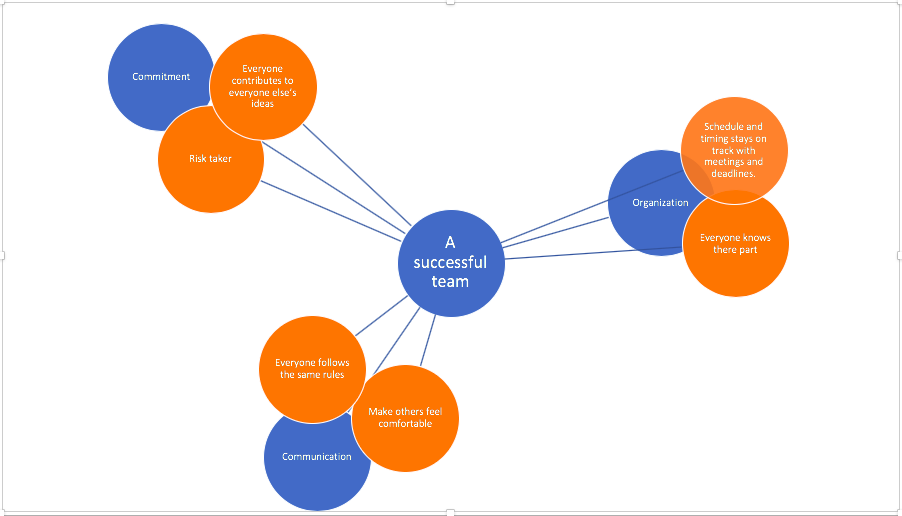
In order to understand what makes a successful team my partner and I have a created a conceptual model consisting of at least 5 skills and strategies that contribute to team success. As you can see in our model, we are mainly focused on the idea of communication, organization, and commitment. These main concepts can each be accomplished in two ways or more.
Let’s start off by exploring what role communication has in making a successful team. Communication is considered as one the most important factors contributing to team success, because it improves personal relationships and increases a person’s commitment to a team (Goleman, 2004). However, the issue with communication is that often times, many people do not speak or communicate effectively. Therefore, it is always important to let someone feel like they have a voice, to feel like they belong, and to feel like they are able to speak their minds with no one clouding their judgement (Goleman, 2004). With that being said, communication does require some emotional aspects in order to improve. Communication can also be important when determining roles within a team. When you establish roles and talk amongst your members about the responsibility that each role has, your team is establishing trust within the members to complete each task. This form of communication also teaches members the different ways to communicate and properly reach everyone effectively. The best way to determine the best mode of communication is to have this predetermined but also a method in where all members have access to speaking with another.
Besides communication, motivation is also one of the factors that contribute to making a successful team (Goleman, 2004). Motivation is not only gained through inspiration but also through communication in ways that team members can gesture politeness into their speech in order to achieve a desired outcome (Colquitt, LePine & Wesson, 2017). A great example of this was written in an article, that stressed the communication between a leader and his or her team. In the article, the author spoke about emotional intelligence and how important it was for a leader to communicate their ideas and goals to their team (Colquitt, LePine & Wesson, 2017).
However, in order to make sure that all team members are in the same boat, in terms of agreements and distributed work, everyone needs to communicate effectively. For example, this group project started off with a membership contract which consisted of a list of questions and scenarios in which group members had to discuss all the possible consequences that would take action if things were not to go as planned.
This is considered a very important factor in the communication part of our conceptual model because we believe that it is important for a group to specify their goals and steps prior to starting a project. Although this could potentially fit into the organization aspect of the model, communication was the best fit because it helps clarify the miscommunications and brings everyone to a compromise when setting rules and determining the level of skill that each person brings to the group (Cross et al., 2008).
Our second most important concept of the conceptual model is organization, which also includes two factors that contribute to team success. The first factor is to make sure that every team member has a role (Goleman, 2004). Having a role means taking a part in the process. Whether you are given the role of the leader, the ambassador, or whatever role it is that you are assigned to do, everyone is given the chance to take on a responsibility. Being in charge of something also gives you a sense of direction in your work and what you need to do.
This will also help the group with balancing the workload because it is especially hard to work as a team if everyone only relied on the leader (Cross et al., 2008). Therefore, since everyone has their own set of skills that they can contribute to the project, it is only fair that everyone has an role in order to make use of their skill.
The second factor that makes up organization is time management. Although time management could be its’ own section in the model, my partner and I have agreed that it would fit best with organization in terms of setting priorities and goals for the team. This is considered as organization because it helps us manage our time with all the tasks that we need to complete within a given time.
Another form of organization that would be successful to a team is having a member who writes everything down. This could be summary of meetings, deadlines, equally distributing the tasks, etc. For example, when I met with my partner for this project, we spoke about what needed to be done, who would take a specific task, and our desired goal by the end of the project. By establishing organization this way, the management of this team is split up between both of us equally in order to spread out work and to work efficiently.
The last section of the conceptual model is commitment, which determines the level of dedication and the amount of effort that each member contributes to their team. This definition is quite similar to the definition of motivation as well, which is stated as, the feeling that increases our level of determination and effort. In this project, we both believe that the time and effort that we spent dedicated to this website will show in the final results. Therefore, it is important to keep high commitment throughout the entire project and not just toward the end, because when you commit fully through the entire project, you show high commitment and the results of your project will be promising (Dubin, 2005).
By motivating your team members, you can also increase their level of commitment (Colquitt, LePine & Wesson, 2017). However, the level of commitment is often affected by emotions and feelings that we have toward our group. Therefore, as previously mentioned, it is necessary that people make others feel like they have an opinion and a voice in the group. By doing so, we increase communication as well the trust in one another, making us feel more dedicated to work with others toward a group goal. This means that team members should speak up when they feel like they have more effective ideas or ways to go about the project. This also means to praise each member for their hard work and scold other members when they are slacking (Goleman, 2004).
Commitment can also be increased through engagement and is most effective when a person likes what they are doing (Goleman, 2004). For example, someone who enjoys arts and crafts is very likely to spend more time and dedication designing a visual aid versus other tasks given within a group presentation. This is also known as coordination loss, which is described as the unbalanced effort and dedication between a person’s tasks (Goleman, 2004). In comparison, when someone is participating in something they do not enjoy doing, to show high levels of commitment throughout the entire task shows their team members that they are willing to cooperate and work well with others.
As previously mentioned above, it is important that everyone is responsible for some part of the team task, thus the name “teamwork.” However, sometimes the expectations and abilities of those in a team are limited, which can often lead to a process loss, defined as, getting less output than we expected from a group (Goleman, 2004). Therefore, we believe that it is always better to have team members contribute to our ideas. In other words, we should always proofread and look over each other’s works because everyone has a different skill level. This also helps us believe that by looking over everyone’s work and giving each member our approval, that there is a high level of trust and communication within the group, which leads to success.
In terms of skill, they can always be improved and enhanced through new experiences. With this, we dive into our last element of the conceptual model, risk takers. Risk taking does not mean making last minute decisions. It means being open to new ideas and challenging ourselves to trying something new. As stated in an article, each situation that we come across in our lives can be similar to our past experiences but never the same and every new experience that we face will always require a new skill that we have not yet learned (Dubin, 2005).
Although commitment is about the dedication and effort of the group, it also depends on the task that is given. For example, a complex task or a time consuming task in this case as well as the level of difficulty given. Although this project was mainly set up for a group of three but due to an even number of students, our group only consists of two members. Therefore, we divided the work according to our level of skill.
Of course we can always have our members help contribute to our ideas because they might have already learned a skill that we haven’t. But as we take on the challenges and accomplish a given task, we come to develop a new skill that we can later contribute to the future.
Looking back at our conceptual model, our main concepts consisted of communication, organization, and commitment, elements which had 6 important factors that contributed to team success. With the help of 3 articles and some previous lecture material, we learn that communication increases commitment and organization within a team while also providing motivational aspects as well as encouraging many of us to take on new challenges as a risk taker. However, in order to understand more about how the conceptual model applies to our daily activities, my partner and I have prepared three examples on the following pages on how these factors helped contribute to some of our past experiences.
For example, one of the experiences is mainly catered toward communication, in which one of us had to apply this skill in order to get our ideas across to every team member. Communication was also heavily used when it came to the level of commitment in which people needed to discuss the best strategy to use. Organization came in the form of order, in which team members had to strategize their order of approach in order to gain the best results possible.
With each experience we only hope to develop more skills and to strengthen the ones that we already have. Therefore, with the personal experiences that we have provided, we hope that you can also learn from our those experiences, strengthen some of your skills, and develop some new ones of your own for future purposes.
References:
Cross, R. , Ehrlich, K. , Dawson, R. , & Helferich, J. (2008). Managing collaboration: Improving team effectiveness through a network perspective. California Management Review, 74.
Dubin, H. (2005). Building high-performance teams. Chief Learning Officer, 4(7), 46-49.
Goleman, D. (2004). What Makes a Leader?. Harvard Business Review, 82(1), 82-91.
Colquitt, J. A. , Lepine, J. A., & Wesson, M. J. (2010). Organizational Behavior: Improving Performance and Commitment in the Workplace, 2nd Ed.
Burr Ridge, IL: McGraw-Hill, Inc.
 Successful teams